
I’m in the midst of a major rewrite of An Unremarkable Girl at the moment. It’s a top-to-toe affair. Our first draft of the manuscript was not “bad” per say, but my writing especially came off more as a compendium of analytical essays about the various psychological and cultural concepts that have affected my life rather than a memoir of a transgirl fighting to assert her identity in the face of many challenges. It was antiseptic in many places, as opposed to being visceral, which is what a good memoir should be.
As I write along, following a stricter chronology than the first draft, I’ve come to a section that really needs to be about the happy parts of my childhood, the amazing food, the trips to Europe, the loving attention and near-infinite patience my parents showed me throughout my elementary school years. This should be a piece of cake, I keep thinking, because happy idylls are nice to write about. This doesn’t have to be viscerally painful. Or does it?
Here’s the thing- I’ve always preferred writing tragedy. My short stories are usually set in the Soviet Union during the Second World War or the decade following it, i.e. in a bleak war-ravaged and psychologically damaged country, following the travails of partizans, veterans, and others who gave their bodies and souls for the Motherland. Why? Because aside from my historical passion for Stalin’s Soviet Union, it’s easy to find drama and plot in that particular period of history. There’s a lot of pain, a lot of conflict, and some great stories to be told against the backdrop of war and the painful, jerky recovery from that war.
So when I’m called, as I am now, to write about the good times in my own life, my Schreibdrüse (“writing gland” in German), suddenly shrivels up. It’s not as interesting or naturally compelling to me to write about good times because they lack conflict, but it is also harder for me to write about good times in my own life because I’m still grieving their loss. When my parents told me they were getting divorced, in August of 2008, that world, the world of dinner parties and nearly annual trips to Europe, was lost. I still bear the bruise from that cosmic punch to the gut.
That bruise doesn’t sting when I write about the divorce. I’ve talked about the divorce a lot, I’ve been in therapy for a decade and have spent perhaps 45% of that time working through my issues around that cataclysm. I’m over the divorce in and of itself. What I’m not over is the loss of the halcyon days of childhood. When I recall them, that bruise stings and aches. Hence the Schreibdrüse shrivelling problem.
I still have to write it. Without the happy times as context, my parents’ sudden divorce won’t hit the reader the way it hit me, like a ton of bricks falling from a clear blue sky, and that’s a necessary part of the book. To understand why my teenage years were such a special kind of hell it needs to be prefaced by how heavenly much of my childhood was. So I’m trying to slog through it, and “slog” really is the word, as I feel with this portion that I’m trying to traverse a swamp after knocking back ten large gin and tonics.
So I tempt myself onward. I reward myself with a cigarette after an hour of banging my fingers against the keys, even if the end result is essentially pond scum in written form. I bait myself by saying “you can write a depressing story about Russia just as soon as you finish this.” Eventually (and hopefully in the very short future), I’ll have written a whole coherent piece about the halcyon and happy days. And when I have, I will write such a tragedy as the world has never seen.
(I have to write about this: Pot au Feu, wonderful French dinners with fine wines that my parents and I shared every night. I grew up on two and three course dinners, with a fantastic chef for a father. I was a spoiled kid.)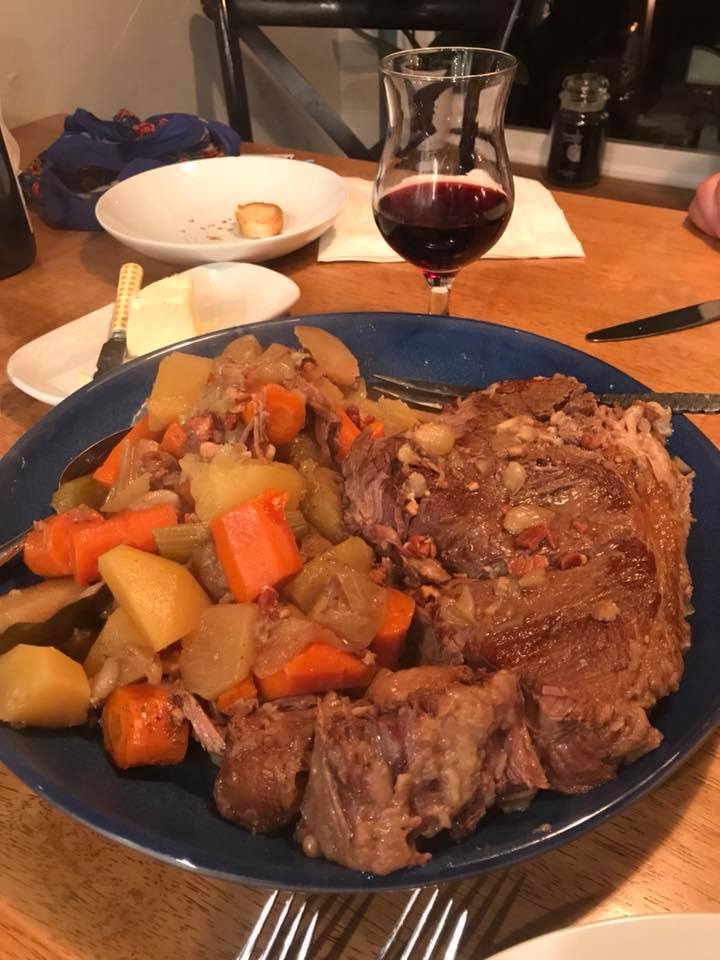

 Remarks From an Unremarkable Girl